
The Deadline to Save the Internet Just Moved to 2029

Everything we do online runs on locks. Websites, banking apps, chats and software updates all rely on public-key cryptography, the maths that lets two strangers agree on a secret over a public wire and lets your phone check that an update is real.
But there's a day with a name for when those locks stop working. Q-day: the day a quantum computer can break the public-key encryption that protects today's internet.
And this year it moved closer. On 7 April 2026, Cloudflare, whose network sits between browsers and the websites they visit, announced: "We now target 2029 to be fully post-quantum (PQ) secure", meaning safe against quantum computers. It added that Google has also brought its own migration forward to 2029 (cloudflare.com). Their reason, in their own words: "Credible new research and rapid industry developments suggest that the deadline to migrate is much sooner than expected."
Why this matters for you: if those locks fall, so do your banking login, your private messages and the updates your devices trust. And anything stolen from you today could be opened then.
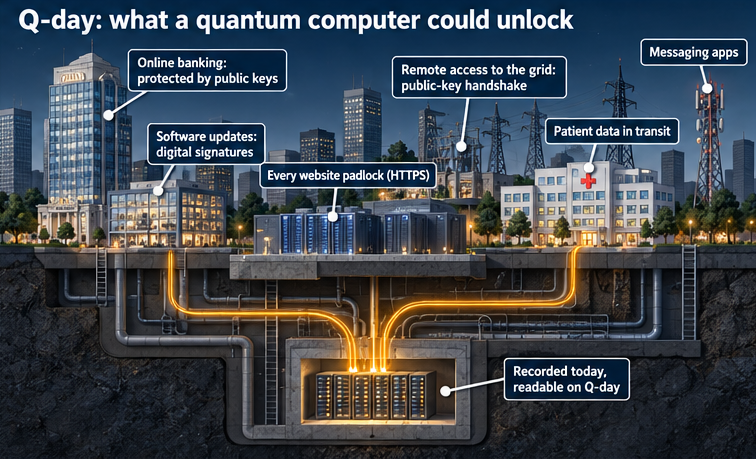
Notice the vault at the bottom: the recording happens today. Only the reading waits for Q-day.
Honestly, I thought nobody was doing anything about this except the secret services. Then I went through the government roadmaps one by one and found dates from the US, the EU, the UK and the G7. I was partly wrong. More on that below. First, why I think the clock runs faster than it looks.
AI is helping with unsolved maths
On 20 May 2026, a team at OpenAI used a model to disprove a conjecture by Paul Erdős from 1946 on the unit distance problem (arxiv.org). Other mathematicians, among them Tim Gowers and Will Sawin, checked and wrote up the proof, and Sawin's paper credits "a team at OpenAI" (arxiv.org).
A conjecture from 1946. Disproved with help from a model.
To be clear: that result has nothing to do with encryption, and nobody has shown AI breaking it. My point is pace, and it's my opinion only. If a model can help disprove a conjecture that stood for 80 years, I find it hard to believe the quantum side stays slow for long.
What the experts expect
The Global Risk Institute asked 26 experts for its Quantum Threat Timeline Report 2025. Their view: a quantum computer able to break today's encryption is "quite possible (28-49%)" within 10 years and "likely (51-70%)" within 15 years (globalriskinstitute.org).
The hardware bar keeps dropping too. In May 2025, Craig Gidney of Google Quantum AI estimated that RSA-2048, one type of public-key lock, could be broken with fewer than one million noisy qubits (the error-prone building blocks of a quantum computer) in under a week, down from about 20 million qubits in a 2019 estimate (arxiv.org).
Twenty million to under one million. Same lock.
Who is acting
Here's where I was wrong. Turns out governments, the G7 for the financial sector, Cloudflare and Google have all published dates.
- The US. Executive Order 14412 requires federal agencies to move their most sensitive systems to post-quantum encryption by 31 December 2030 and to post-quantum authentication by 31 December 2031 (cloudflare.com).
- The EU. The coordinated roadmap from June 2025: member states start by the end of 2026, high-risk use cases move by the end of 2030, full transition by 2035 where feasible (digital-strategy.ec.europa.eu).
- The UK. The NCSC roadmap from March 2025: identify and plan to 2028, high-priority upgrades in 2028-2031, complete migration for all systems in 2031-2035 (ncsc.gov.uk).
- Finance. The G7 Cyber Expert Group published a financial-sector roadmap in January 2026 that points to 2035 as the overall target and to around 2030-32 for critical systems (home.treasury.gov).
- Cloudflare and Google. Both target 2029 (cloudflare.com), and most browser traffic to Cloudflare is already post-quantum protected (cloudflare.com).
So the big players are moving, and I'm glad.
Who lags
Everyone below that layer, as far as I can see. Two numbers from Cloudflare show the gap: about 70% of browser traffic to Cloudflare already uses the new quantum-safe locks, but only about 15% of the origin servers Cloudflare connects to (the websites' own machines) support them (cloudflare.com).
On Cloudflare's network, the browser side is mostly done. The server side, the websites themselves, mostly isn't.
And the G7 roadmap for banks is non-binding; it "does not set guidance or regulatory expectations" (home.treasury.gov). A date nobody has to hit is a wish.
What breaches already cost
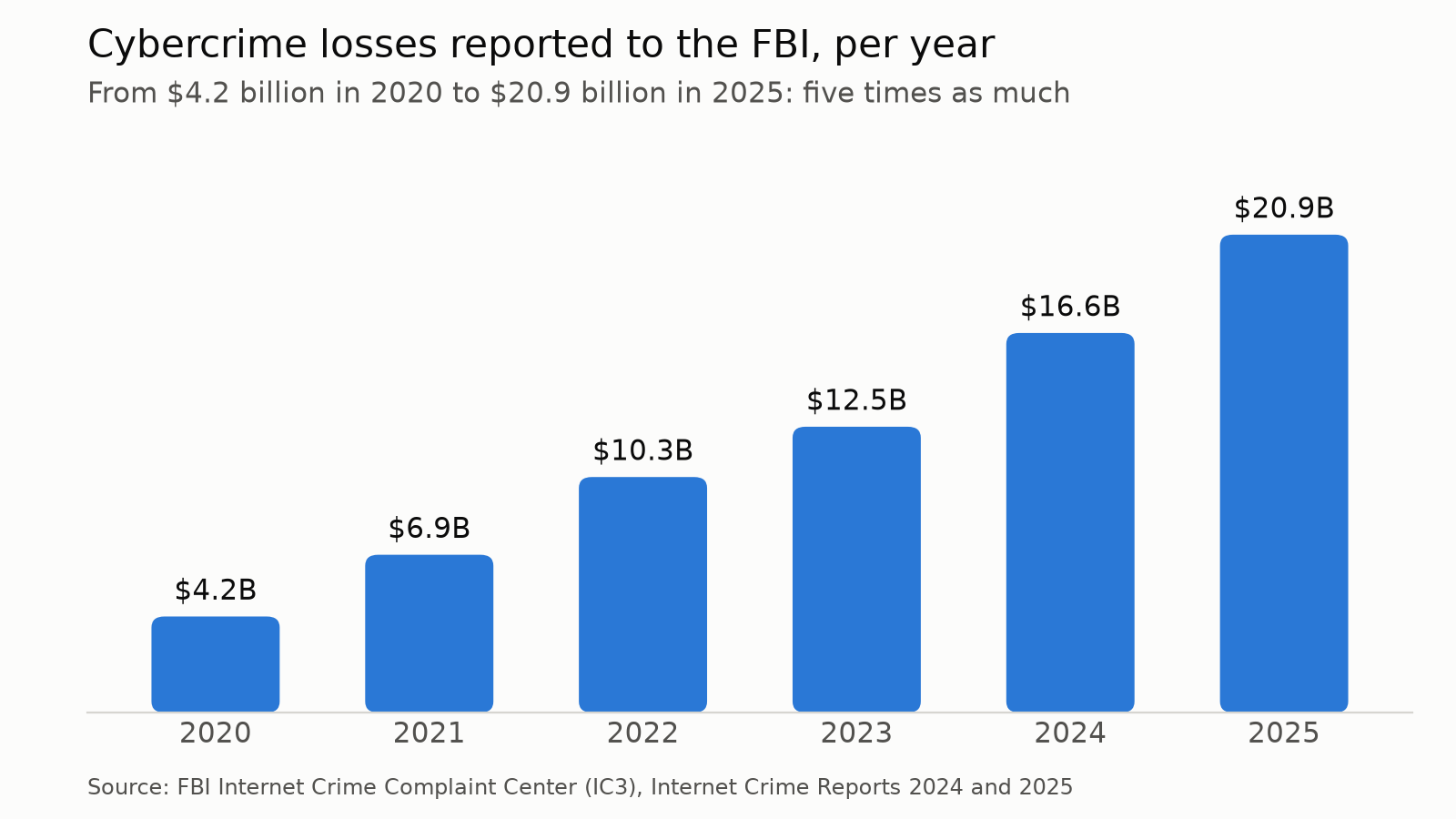
That's ordinary cybercrime, with every lock still working, and the losses reported to the FBI have grown every year since 2020. Now picture the same criminals with the locks gone.
Reported losses reached $20.9 billion in 2025, up 26% on 2024 (ic3.gov). No quantum computer needed.
History repeats: WannaCry
In May 2017, the WannaCry cyber attack hit the NHS in England. At least 81 of 236 NHS trusts (the bodies that run local NHS services) were affected, plus 603 other NHS organisations, and an estimated 19,000-plus appointments were cancelled (nao.org.uk). NHS Digital had sent alerts in March and April 2017 telling organisations to patch, and the National Audit Office found the disruption could have been avoided with basic security (nao.org.uk).
The warning came. The patch existed. It wasn't installed in time.
And it didn't end in 2017. Two years later, in August 2019 alone, the security company Sophos blocked more than 4.3 million attempts by WannaCry-infected machines to spread (darkreading.com).
That was one patch for one bug. Q-day isn't a patch.
The long timeline isn't my estimate. It's history. When NIST opened its call for post-quantum algorithms in 2016, it wrote: "Historically, it has taken almost two decades to deploy our modern public key cryptography infrastructure" (theregister.co.uk).
Almost two decades for the last rollout. Now set that against the expert odds above, and against the roadmaps that run to 2035. If Cloudflare is right that the deadline is sooner than expected, 2035 is late.
What we should do
My opinion, plainly:
- Act as if it's already here. The G7 roadmap warns about "harvest now, decrypt later": steal encrypted data today, open it once a quantum computer exists (home.treasury.gov). Anything stolen today that stays sensitive for years (medical records, contracts, state secrets) is already at risk.
- Awareness. Q-day needs to be as familiar a word as ransomware. Right now it isn't.
- Initiatives with teeth. Warnings without consequences didn't save the NHS. Dates with consequences might.
- Massive investment, below the top layer. Only about 15% of the websites behind Cloudflare support the new locks on their side (cloudflare.com). My guess: the rest is the long tail of small companies, old systems and nobody's budget.
The Limitations
- No publicly known quantum computer can break this encryption today. Gidney's estimate is under a million qubits, and he's clear the hardware doesn't exist yet (arxiv.org).
- The expert odds are a survey, not a measurement. They're the estimates of 26 people (globalriskinstitute.org).
- The AI link is my opinion. The Erdős result is maths, not cryptography. Nothing in this post shows AI breaking encryption.
- The traffic numbers are Cloudflare's network, not the whole internet (cloudflare.com).
- The FBI chart is all cybercrime, not quantum. It's here to show what breaches already cost with the locks still working.
I thought nobody was moving. The big players are, with published dates between 2029 and 2035. Everyone below that layer looks like the NHS in 2017: warned, patch available, not installed. We should act as if Q-day has already happened, because for any data stolen today, the clock has already started.