
Can AI Coach Articulation and Voice Modulation? Here's What's Possible Today
Articulation is how clearly you form sounds and words. If a child says "wabbit" for "rabbit," that's a substituted sound, one of the patterns clinicians list as a sign of a speech sound disorder (asha.org). Voice modulation is everything wrapped around the words: pitch, pace, volume and tone, the difference between sounding alive and sounding flat (toastmasters.org).
Together they decide how you come across at work, technical people included. Engineering accreditors literally require "an ability to communicate effectively with a range of audiences" (colorado.edu).
AI apps now exist that listen to you talk and coach exactly this. The human coaches one user priced run "$300+/hour usd" (reddit.com), and your colleagues won't flag your pronunciation, because "people are too polite to point out personal deficiencies to your face" (apps.apple.com).
But here's the catch: almost no app trains both skills. So which tool fits your exact speaking goal? That's what I set out to answer.
The Two Skills, in Plain Words
Speech clinicians split clear speech into two problems. The first is articulation, the motor production of speech sounds (asha.org). Your tongue, lips and jaw hit precise positions for every sound; miss one and "banana" comes out "nana" (asha.org). This is the skill accent coaches and pronunciation apps train.
The second is voice modulation, what Toastmasters calls vocal variety: "the intentional shifting of your voice to create meaning, emotion, and audience engagement" (toastmasters.org). Its levers are pitch, pace, volume and tone. Say "we shipped on time" with a lift on the last word and it's a question; say it flat and nobody looks up. The baseline quality of your voice, "its pitch, volume, and tone," is set by the size and shape of your vocal folds and the cavities that resonate them (nidcd.nih.gov). How you play that instrument is trained. This is the skill delivery coaches and public-speaking apps train.
Articulation is the sounds. Modulation is the music.
Why Both Matter at Work
The stakes are not soft. LinkedIn's analysis of its 1 billion global users put communication at No. 1 on its 2024 list of most in-demand skills (fortune.com). A Grammarly and Harris Poll survey estimated ineffective communication costs U.S. businesses up to $1.2 trillion a year, with leaders estimating teams lose 7.47 hours a week to it, roughly $12,506 per employee per year (agilitypr.com).
And it's not just surveys; it's been measured in experiments. When hypothetical employers and professional recruiters heard job candidates' pitches instead of reading them, they rated the candidates "more competent, thoughtful, and intelligent" and were more interested in hiring them (pubmed.ncbi.nlm.nih.gov). In a mock-interview study, U.S. participants evaluated an applicant for a human resource manager position from an audio recording: "the applicant with the Midwestern US accent was evaluated more positively than the applicant with the French accent" (pubmed.ncbi.nlm.nih.gov). In a third, people voted between higher- and lower-pitched versions of the same voice saying "I urge you to vote for me this November," and "both men and women select male and female leaders with lower voices" (pubmed.ncbi.nlm.nih.gov).
The words were identical. Only the voice changed.
The demand shows up in the forums too. One r/SpeakBetter poster "transitioned into a higher role which requires cross-function communication" and suddenly had to fix how they speak (reddit.com). Plenty of apps promise to fix this. The catch is which "this" they mean.
Why One App Won't Fix Everything
I pulled 85 Reddit posts with 218 comments and 608 App Store and Google Play reviews across a hand-picked set of apps, using three Apify actors (harshmaur/reddit-scraper, automation-lab/apple-app-store-scraper, code-node-tools/google-play-reviews-scraper) for $1.24 total.
As a side note, I scraped reviews sorted by "most helpful," which leans more critical than the overall store ratings, and the theme counts below are keyword matches, not human-coded labels.
The split in that data is almost surgical.
- Pronunciation apps talk about sounds, not melody. In BoldVoice's most-helpful reviews — 60 from the App Store, 60 from Google Play — 58 reviews touch articulation, pronunciation or accent, and only 4 touch pitch, tone, pace or volume (apps.apple.com, play.google.com). ELSA Speak: 29 against 4 (apps.apple.com, play.google.com).
- Delivery apps talk about melody, not sounds. Voice Analyst's reviews bring up pitch, tone, pace or volume in 20 of them and articulation in exactly zero (apps.apple.com, play.google.com). Speeko's reviews hit that same delivery theme in 16, and its own site sells WPM pace tracking and intonation feedback (apps.apple.com, speeko.co).
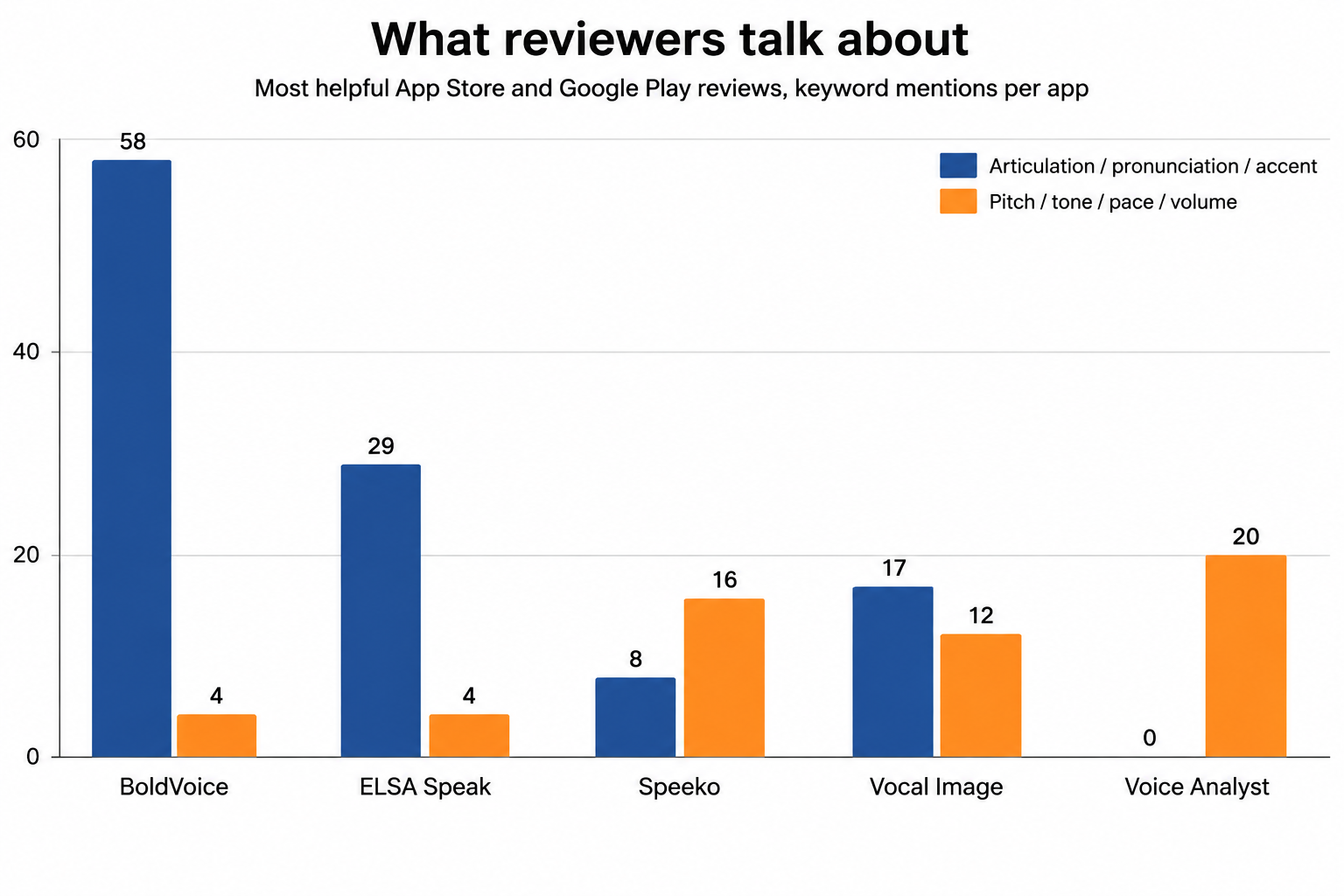
Notice the corners. The two pronunciation leaders almost never mention pitch, and the pitch leader never mentions articulation.
In a nutshell: these are two different problems sold as one category. A pronunciation app won't coach your melody. A delivery app won't fix your sounds. Buy one for the other's job and you've wasted a subscription.
So if your problem is how you pronounce English, which one wins?
Best for Articulation and Pronunciation
BoldVoice: The Stricter Accent Coach
BoldVoice sits at 4.81 across 54,270 ratings on the US App Store (apps.apple.com) and 4.69 across 12,879 on Google Play (play.google.com). Its whole pitch is accent coaching: video lessons from Hollywood accent coaches, interactive mouth diagrams, and sound-by-sound analysis of every word you pronounce (apps.apple.com).
The most-upvoted review in my pull explains why it works. The key to a foreign accent is tongue position, and BoldVoice "REALLY captures those little off-positions your tongue accidentally slips into and lets you know" (apps.apple.com). Of its 58 articulation mentions, 49 came from 4 and 5 star reviews.
It also grades harder than its rival — at least, two Redditors who ran both say so. One r/EnglishLearning poster "got slightly lower scores for my pronunciations on BoldVoice than ELSA" (reddit.com), and a commenter put numbers on it: "When ELSA says I am 85 to 91% like a native speaker, BoldVoice only gives me 80 to 81%" (reddit.com).
If you want a coach that doesn't flatter you, this is the one.
ELSA Speak: The Bigger, Looser Alternative
ELSA is the giant: 4.75 across 115,185 App Store ratings, 4.60 across just over a million Google Play ratings, and 92M+ downloads claimed on its site (apps.apple.com, play.google.com, elsaspeak.com).
Its party trick is word-level fixes. One reviewer in the US for over 36 years had fought the word "world" for 26 of them; ELSA suggested replacing "OR" with "R" or "ER," and "the word that I had trouble with for 26 years now requires no effort" (apps.apple.com). Its Speech Analyzer gives instant feedback on free speech, there's exam prep for IELTS, TOEFL and TOEIC, and one reviewer mentions a Lifetime Pro membership bought outright (apps.apple.com).
The cracks: 19 of its scraped reviews mention bugs or crashes, against BoldVoice's 5. One fan still hit two crashes in 2 to 3 hours and warned against using it on VPN (apps.apple.com). On r/EnglishLearning, one poster complained the orange and red highlights don't say what exactly was wrong and that the algorithm is "totally easy to fool" by artificially intonating; a reply pointed out that clicking the red highlights gives you more information (reddit.com, reddit.com).
BoldVoice grades harder, per two Redditors. ELSA counters with 8,000+ lessons. That's the whole fight.
But what if your sounds are fine and your delivery is the problem?
Best for Voice Modulation, Pitch, and Pace
Three tools, three philosophies: a coach, a gym, and a graph.
Speeko: The Delivery Coach (Stick to iOS)
Speeko tracks pace, intonation, fillers, sentiment and talk time, with sample feedback like "Your average pace is 145 WPM" and "You can convey more emotion by adding pitch variety" (speeko.co). There's exclusive content from voice coach Roger Love, and users love the reps: a random topic generator that forces fast thinking with a review every two minutes, and a healthcare worker who warms up with it before difficult conversations about a patient's diagnosis (apps.apple.com). 14 of its 16 pitch and pace mentions came from happy reviewers.
Here's the catch, and it's huge. On the App Store, Speeko sits at 4.71 across 4,781 ratings. On Google Play, it's 2.13 across 49 (apps.apple.com, play.google.com). The company lists iOS, macOS, Android and web (speeko.co), but something is clearly going wrong on the Android side.
4.71 on iOS. 2.13 on Android.
Vocal Image: The Voice Gym
Vocal Image is the closest thing to a bridge between the two camps: tongue-twister drills with speed and clarity scores on one side, real-time pitch curves on the other, "think Guitar Hero, for your voice" (vocalimage.app). Just know its articulation side is drills and accent work, backed by an Accent Test where the AI pinpoints where your accent is from. It sits at 4.49 across 10,872 App Store ratings and 4.23 across 17,432 on Google Play (apps.apple.com, play.google.com).
The most interesting praise came from a non-binary professional voice teacher, who recommends it for intermediate and advanced speakers, "ESPECIALLY" for transmasc and masc afab non-binary people because "it doesn't put a person into the 'girl' box," plus contraltos and basses. Their caveats: not for beginners without a teacher, and trans femme users should pair it with a trained coach, since it leans toward deepening the voice (apps.apple.com). Another reviewer gained high notes they couldn't hit before, plus a more powerful lower octave, over six months (apps.apple.com).
One red flag on its community ratings, which I saved for the traps below.
Voice Analyst: The Graph
Voice Analyst isn't a coach at all. It's a measurement tool: live graphs of your pitch in hertz or musical notes and your volume in decibels, min, max, range and average stats, and target bands you try to stay inside. One purchase, $17.99, no subscription (apps.apple.com, speechtools.co).
The credibility is real. It's created by speech and language therapists, used in clinics, hospitals and homes across 184 countries, with 12 million recordings analysed, and it's listed in the Parkinson's UK tech guide (speechtools.co). Reviewers back it up: "My speech therapist recommended it" (play.google.com), "recommended by my speech pathologist" (play.google.com).
Just know what you're buying. One disappointed reviewer nailed it: "there is no programme in the app to guide you... it simply measures this" (play.google.com). Another got different min and max pitch values when loading the same clip twice (play.google.com).
Not a coach. A ruler.
So what about rehearsing the actual conversation before you have it?
Best for Live Practice, Roleplays, and Free Options
Yoodli: The Funded Favorite
Yoodli is where the money went. In December 2025 it locked in a $40M Series B, lifting its valuation from roughly $100M to $300M+ in under half a year (reddit.com). The product is AI roleplays: sales calls, job interviews, feedback sessions and leadership talks, with feedback on speech, pacing and clarity (reddit.com) — and the site claims a 4.8 rating over 1M+ trained (yoodli.ai). Toastmasters made it a benefit for all 300,000 members (reddit.com).
For individuals, there's a free Starter plan with 5 lifetime roleplays, Pro at $8/month billed annually for up to 10 roleplays a week, and Advanced at $20/month billed annually (yoodli.ai).
Orai: The Quick Scorecard
Orai is the lightweight option: speak, get a scorecard on filler words, pace, clarity, energy, confidence and conciseness, built for presentations, speeches, interviews, meetings and sales pitches (apps.apple.com). Its site claims users who finish 10 or more sessions cut median filler-word use by 23% across 4,280 users, with 71% improving at least two measured skills (orai.com). One reviewer got it on a friend's suggestion to practice for an oral argument in law school (apps.apple.com).
Worth knowing: a Google Play reviewer warned "I could talk in all kinds of strange ways and still score well" (play.google.com). Treat its scores as a nudge, not a verdict.
ChatGPT Voice Mode: The Free Warm-Up
When one poster described moving from a technical environment into a business role, a commenter on r/PublicSpeaking said they'd pick ChatGPT on voice mode. Their recipe: open ChatGPT's voice mode, state your issues and fears clearly, give it specific instructions to be your communication coach, converse, and ask it to flag when you get too technical or non-social (reddit.com). "Nothing to lose as its free!"
And Cross Off Poised
Poised's only appearance in my Reddit pull was someone listing it among apps they hadn't tried (reddit.com), and its homepage now announces "Poised is shutting down on 10/8/2026" (poised.com). It plugged into 800+ tools including Zoom, Google Meet, Slack and Microsoft Teams, on Mac and Windows.
Doesn't matter. Don't build a habit on a product that's already gone.
Side-by-Side Comparison
Everything above on one screen:
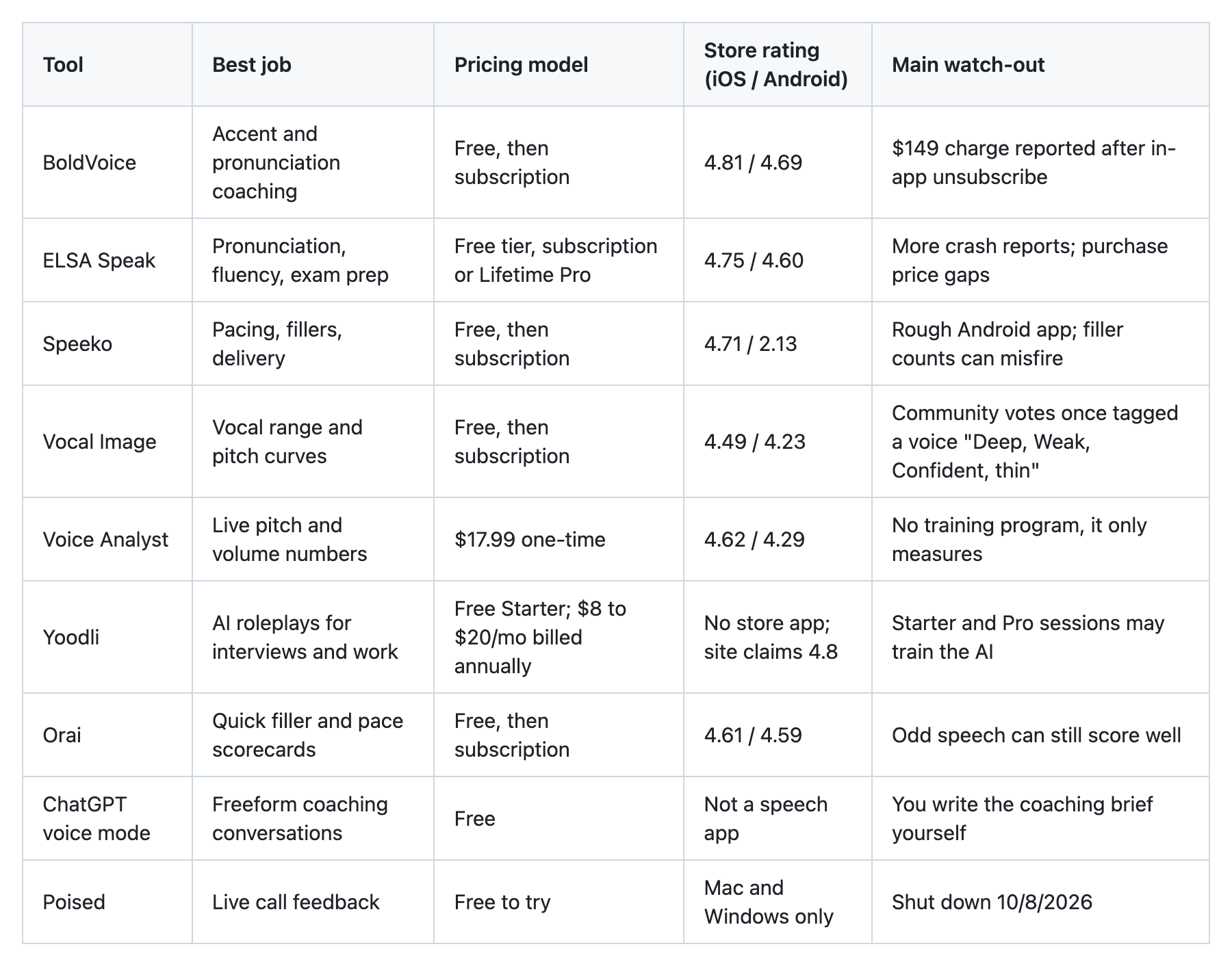
Notice the rating column. Speeko is a 4.7 app on an iPhone and a 2.1 app on Android.
Three Traps Before You Subscribe
Of course, there are limits. Three kept surfacing — in the low-star reviews, the pricing fine print, and on Reddit:
- Billing is the top complaint in every subscription app I checked. Price and billing was the number one theme in the low-star reviews of all five subscription apps. BoldVoice charged one user $149 after they unsubscribed in the app (play.google.com). Vocal Image took $80 during what was promised as a free trial (apps.apple.com). An ELSA user paid $117 in the app, then found a $40 yearly choice in their Apple account settings (apps.apple.com). An Orai user was charged the full year before the 7-day trial ended, then found the cancellation would not take effect for 12 months (play.google.com). Cancel through the store, not the app, and screenshot everything.
- The scoring can be fooled or broken. Speeko told a careful speaker they used 17 filler words, then graded an "um"-stuffed redo as fluent with 6 (apps.apple.com). Vocal Image's community Voice Rating labeled a recording of pure silence "Deep, Weak, Confident" (apps.apple.com). One r/JudgeMyAccent user fed a standard AI voice (Google Translate) into BoldVoice's accent guessing and it "STILL guessed my exact city," which made them suspect metadata, not audio (reddit.com).
- Check whether your voice trains the model. On Yoodli's free Starter and $8 Pro plans, session data may be used to improve the platform. The $20 Advanced plan and the business tiers exclude your data from AI training by default (yoodli.ai).
The Bottom Line
There is no single best AI speech coach, because articulation and modulation are different jobs. If people ask you to repeat yourself, start with BoldVoice and let it grade you hard, or ELSA if you want 8,000+ lessons and a lifetime option. If people understand you but tune out, go Speeko on iOS or Vocal Image's pitch curves, with Voice Analyst when you want numbers a speech therapist would recognize. If you freeze in interviews or hard conversations, Yoodli's roleplays are the closest thing to a human coach, and ChatGPT voice mode is the free warm-up. Just don't pick Poised.
Copy this checklist:
- People ask you to repeat yourself. Start with BoldVoice for strict accent coaching, or ELSA Speak for the 8,000+ lesson library and Lifetime Pro plan.
- One stubborn sound, like "world". ELSA's word-level fixes.
- Flat, rushed or monotone delivery. Speeko on iOS, or Vocal Image if you want to see and match pitch curves.
- Therapy homework with real numbers. Voice Analyst, $17.99 once, no subscription.
- Interview, meeting or difficult-conversation reps. Yoodli roleplays from $8/month billed annually, or ChatGPT voice mode for free.
- Filler words. Orai's scorecards.
- Live call feedback. Nothing on this list. Poised shut down 10/8/2026.
Your colleagues are too polite to correct you. These apps aren't. Happy rehearsing.